

Quick Answer: Ben Sasse is a Republican politician, author, and academic who served as a U.S. Senator for Nebraska from 2015 to 2023. Born on February 22, 1972, in Plainview, Nebraska, Sasse is known for his frequent criticism of both parties and his outspoken opposition to Donald Trump. He resigned from the Senate in January 2023 to become the 13th President of the University of Florida — a tenure that ended in controversy in October 2023.
Quick Facts
| Detail | Information |
|---|---|
| Full Name | Benjamin Eric Sasse |
| Date of Birth | February 22, 1972 |
| Place of Birth | Plainview, Nebraska |
| Age | 53 (as of 2025) |
| Nationality | American |
| Profession | Politician, Academic, Author |
| Political Party | Republican |
| Spouse | Melissa Sasse |
| Children | Three (Corrie, Alex, Breck) |
| Education | Harvard University (PhD), Oxford University, University of Chicago, St. John’s College (BA) |
| Senate Term | January 2015 – January 2023 |
| University Presidency | University of Florida (February 2023 – October 2023) |
| Net Worth | Estimated $1–5 million (unverified; no public disclosure confirmed as of 2025) |
From Small-Town Nebraska to the National Stage
Ben Sasse’s story begins in Plainview, Nebraska — a small town of fewer than 1,500 people — where he was born on February 22, 1972. Raised in the American heartland, Sasse developed a reputation early on as someone driven by intellectual curiosity and a fierce sense of civic duty.
He went on to study at some of the most prestigious institutions in the world. Sasse earned his Bachelor of Arts from St. John’s College in Annapolis, Maryland, where students follow a curriculum rooted in the Great Books of Western civilization. He later studied at Oxford University as a Rhodes Scholar candidate (unverified; confirm with official sources), then completed a Master’s degree at the University of Chicago and a PhD in American history from Harvard University in 2004. His doctoral dissertation focused on the relationship between religion and politics — a thread that would run through much of his public career.
Before politics, Sasse built a career that spanned government consulting, academia, and university leadership. He served in the U.S. Department of Health and Human Services under President George W. Bush, and later became President of Midland University in Fremont, Nebraska — a struggling Lutheran liberal arts college that he helped stabilize financially during his tenure from 2010 to 2014.
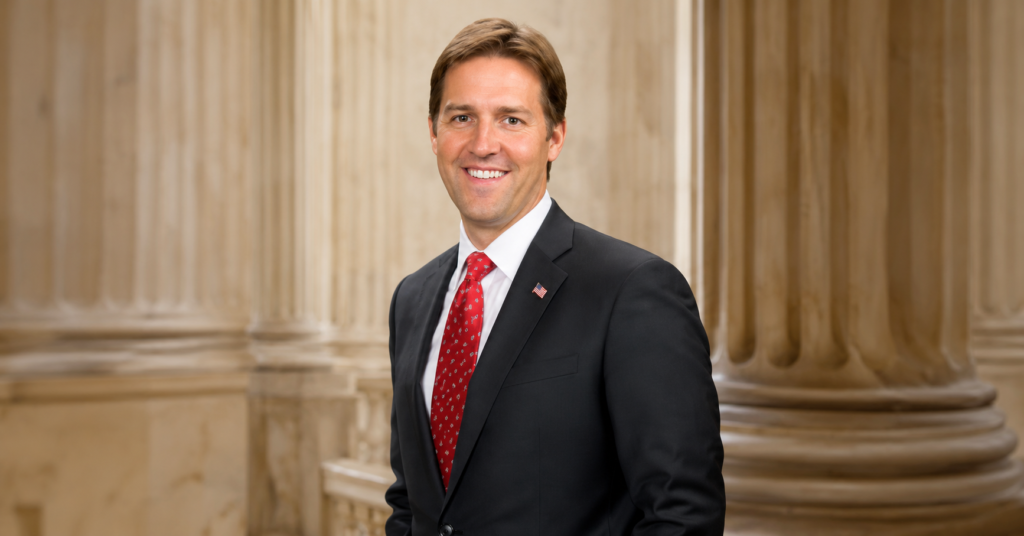
Source: U.S. Senate / Official Senate Portrait (or the original licensed photographer/source where the image was obtained).
Ben Sasse’s Career Timeline
2004 — Completes PhD in American history at Harvard University.
2004–2009 — Works as a management consultant and in the private sector; advises on healthcare policy.
2009–2010 — Serves as Assistant Secretary for Planning and Evaluation at the U.S. Department of Health and Human Services under President George W. Bush.
2010–2014 — Serves as President of Midland University in Fremont, Nebraska, overseeing a significant financial and academic turnaround at the institution.
2014 — Wins the Republican primary for Nebraska’s U.S. Senate seat by a wide margin, defeating incumbent senator Mike Johanns (Note: Johanns did not seek re-election; Sasse ran for the open seat). Wins the general election with approximately 65 percent of the vote.
January 2015 — Sworn in as U.S. Senator for Nebraska, representing the Class 2 seat.
2016 — Becomes one of the most prominent Republican voices refusing to endorse Donald Trump during the presidential primary, calling him “a megalomaniac strongman” in public statements. The tension between Sasse and Trump defines much of his Senate tenure.
2017 — Publishes The Vanishing American Adult, a New York Times bestselling book arguing that American youth are losing the virtues of hard work and self-reliance.
2020 — Re-elected to the U.S. Senate, defeating Democratic challenger Chris Janicek with approximately 63 percent of the vote.
October 2020 — Audio from a campaign call leaks, revealing Sasse made critical remarks about Trump, calling the President’s response to COVID-19 “a catastrophe” and questioning Trump’s character. Sasse declines to retract the comments.
February 2021 — Votes to convict Donald Trump in the second impeachment trial, one of only seven Republican senators to do so. He is censured by the Nebraska Republican Party.
2021 — Publishes Them: Why We Hate Each Other—and How to Heal, further establishing his profile as a critic of political tribalism.
October 2022 — Announces his resignation from the U.S. Senate, effective January 2023, to accept the presidency of the University of Florida.
February 2023 — Formally begins his role as the 13th President of the University of Florida in Gainesville.
October 2023 — Announces his resignation as President of the University of Florida, citing health reasons related to his wife Melissa’s treatment for multiple sclerosis. His tenure lasted approximately eight months.
2024–present — Sasse’s professional plans post-Florida presidency remain publicly undisclosed as of early 2025. (Unverified; confirm with recent news sources.)
Ben Sasse’s Political Career: A Republican Who Broke Ranks
When Sasse arrived in Washington in January 2015, he was immediately different from most freshman senators. He had no prior experience as an elected official, yet he arrived with the confidence of someone who had spent years studying the American experiment in depth.
His early Senate career was defined by a willingness to challenge his own party. He was among the first Republicans to openly criticize Donald Trump during the 2016 presidential primary, a stance that earned him both national media attention and fierce blowback from Trump loyalists in Nebraska and beyond.
Sasse sat on the Senate Armed Services Committee, the Senate Intelligence Committee, the Senate Judiciary Committee, and the Joint Economic Committee during his tenure — assignments that kept him in the middle of major national security and domestic policy debates.
On policy, Sasse positioned himself as a fiscal conservative and a strong defender of civil liberties. He was an outspoken critic of executive overreach — under both Republican and Democratic presidents — and a consistent advocate for First Amendment protections. His Senate record reflects a broadly conservative voting pattern, though his public commentary frequently placed him at odds with the MAGA wing of the Republican Party.
The turning point in his Senate career arguably came in February 2021, when Sasse voted to convict Trump following the January 6 Capitol riot. He was one of seven Republican senators to do so. The Nebraska Republican Party censured him shortly after. Sasse did not back down publicly, a response that cemented his image as a principled dissenter — or, depending on the observer, a politician out of step with his base.
The University of Florida Presidency: Promise and Controversy
When Sasse was named the 13th President of the University of Florida in late 2022, the announcement generated significant buzz — and significant protest.
The University of Florida is a flagship public research university and a member of the prestigious Association of American Universities. It serves more than 60,000 students and consistently ranks among the top public universities in the United States. Landing a former U.S. Senator as its president was, on paper, a major get for the institution.
But Sasse’s appointment was not without controversy from the start. Faculty members at the University of Florida voted overwhelmingly against his appointment during the selection process, citing concerns about academic freedom, his lack of traditional academic leadership credentials, and the political climate in Florida under Governor Ron DeSantis. Protests took place on campus ahead of and following his confirmation by the Board of Trustees.
Sasse took office in February 2023, receiving an annual salary reported at $1.35 million — one of the highest university presidential salaries in the country. He outlined an ambitious vision for the university’s growth and positioned UF as a leader in artificial intelligence research.
His tenure lasted eight months.
In October 2023, Sasse announced his resignation, stating that his wife Melissa’s battle with multiple sclerosis required his full attention. He framed the decision as a personal and family-first choice. The announcement came as a surprise to many in higher education, though observers noted that his tenure had been turbulent and that faculty opposition had never fully subsided.
Ben Sasse’s Personal Life: Melissa, Family, and Faith
Ben Sasse married Melissa Sasse (née Harrington), and the couple have three children together: daughters Corrie and Alex, and a son named Breck. (Full birth details for children are not publicly confirmed; reporting is based on Sasse’s own public statements.)
Melissa Sasse’s diagnosis with multiple sclerosis became a defining personal factor in Ben Sasse’s public life. He cited her health as the primary reason for his resignation from the University of Florida presidency in October 2023, and the couple has spoken publicly about the challenges of managing her condition. Melissa Sasse has been described in published profiles as a strong and independent presence in the family.
Faith plays a significant role in the Sasse household. Ben Sasse is a committed Christian and has spoken and written extensively about the role of religion in American public life. His academic work, and to some degree his political philosophy, reflects a deep engagement with questions of meaning, community, and civic virtue rooted in his religious convictions.
The Sasse family has lived in Nebraska throughout much of his public career, consistent with his identity as a deeply rooted Midwesterner, a theme he returned to frequently in his Senate speeches and books.
Ben Sasse’s Books: Writing as a Public Intellectual
Sasse has published two major books that helped define his public profile beyond politics.
The Vanishing American Adult (2017) argues that American society has failed to instill the values of hard work, self-reliance, and civic responsibility in younger generations. The book became a New York Times bestseller and was widely reviewed, earning praise from across the political spectrum for its diagnosis of cultural drift — if not always for its prescriptions.
Them: Why We Hate Each Other — and How to Heal (2018) takes aim at political tribalism, arguing that Americans have allowed partisan identity to fill a void left by the collapse of genuine community bonds. The book was widely read in Washington circles and reinforced Sasse’s positioning as a thoughtful critic of the political status quo.
Both books reflect the same intellectual sensibility: a historian’s long view, a conservative’s concern for institutions, and a pragmatist’s frustration with ideological excess on all sides.
Ben Sasse’s Net Worth: What We Know
Precise figures on Ben Sasse’s net worth are difficult to confirm with accuracy. Public financial disclosure reports filed during his Senate tenure indicate he held assets in line with a career spent in academia and public service — not the financial profile of someone who built substantial private wealth. Estimates from financial tracking sites place his net worth in the range of $1 million to $5 million, but these figures are unverified and should be treated as approximations only.
His University of Florida salary of $1.35 million per year would have contributed meaningfully to his personal finances during his eight-month tenure. Prior to the Senate, Sasse’s salary as President of Midland University and his work in government consulting represented his primary income sources.
What Comes Next for Ben Sasse?
As of early 2025, Ben Sasse has not announced a return to elected politics, a new academic role, or a specific professional venture. (This information is based on publicly available sources and may have changed; verify with current reporting.)
His exit from both the Senate and the University of Florida within the span of two years leaves his long-term trajectory genuinely uncertain. He is 53 years old — young by the standards of American political and academic leadership — with a Harvard PhD, two bestselling books, eight years of Senate experience, and a public profile that remains substantial.
Whether Sasse returns to the arena, moves into the private sector, or pursues a more private chapter remains to be seen. What’s clear is that he built a career defined by being willing to say uncomfortable things loudly — and that quality tends to have a long shelf life in American public life.
Frequently Asked Questions About Ben Sasse
Where is Ben Sasse now?
As of early 2025, Ben Sasse is no longer serving as a U.S. Senator or as President of the University of Florida. He resigned from the Senate in January 2023 and from the UF presidency in October 2023. His current professional role has not been publicly confirmed. (Verify with recent news sources.)
Why did Ben Sasse resign from the University of Florida?
Sasse announced his resignation as President of the University of Florida in October 2023, citing the need to focus on his wife Melissa’s treatment for multiple sclerosis. His tenure lasted approximately eight months.
Did Ben Sasse support Donald Trump?
No. Sasse was one of the most prominent Republican critics of Donald Trump throughout his Senate tenure. He declined to endorse Trump during the 2016 primary and voted to convict Trump in the second impeachment trial in February 2021 — one of only seven Republican senators to do so.
How many terms did Ben Sasse serve in the Senate?
Sasse served one full term (2015–2021) and was re-elected in 2020 before resigning in January 2023, midway through his second term, to become President of the University of Florida.
What is Ben Sasse’s educational background?
Sasse holds a Bachelor of Arts from St. John’s College in Annapolis, Maryland, a Master’s degree from the University of Chicago, and a PhD in American history from Harvard University (2004).
What books has Ben Sasse written?
Sasse has written two books: The Vanishing American Adult (2017) and Them: Why We Hate Each Other — and How to Heal (2018). Both were New York Times bestsellers.

Sophia Carter is an entertainment journalist and celebrity culture writer with a passion for covering Hollywood news, celebrity biographies, lifestyle trends, and pop culture stories. She specializes in researching public figures, industry developments, and trending entertainment topics to create engaging, accurate, and reader-friendly content. Through her work, Sophia aims to provide readers with well-researched insights and timely updates from the world of entertainment.